

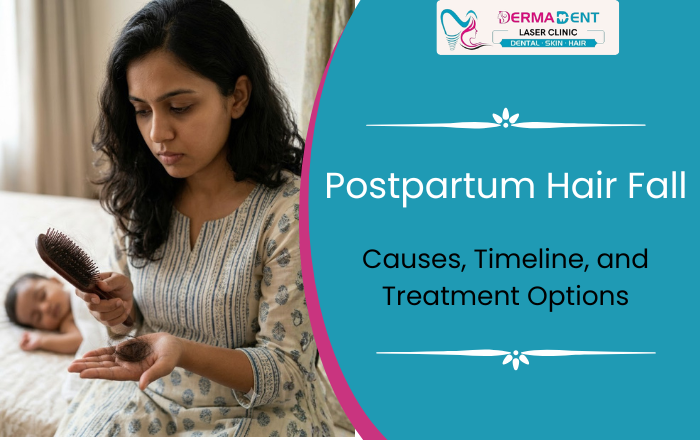
If you’re standing in the shower watching clumps of hair swirl down the drain a few months after giving birth, take a breath. You’re not losing your mind, and you’re almost certainly not going bald. Postpartum hair fall is one of the most common and most alarming-looking changes new mothers experience, and understanding why it happens can take a lot of the fear out of it.
This guide walks through what postpartum hair fall actually is, why it happens, when it starts and stops, and what you can realistically do about it.
What Is Postpartum Hair Fall?
Postpartum hair fall is temporary hair shedding that happens in the months after childbirth, caused by a natural drop in hormone levels. It’s not a disease or disorder it’s your body returning to its regular hair growth cycle after pregnancy temporarily paused it.
During pregnancy, elevated estrogen levels keep more hair strands in the growth phase for longer than usual, which is why many women notice thicker, fuller hair while expecting. After delivery, estrogen levels fall sharply, and all that “extra” hair that was held back suddenly moves into the shedding phase at once.
Why Does Hair Fall Increase After Pregnancy?
Hair grows in cycles: a growth phase (anagen), a short transition phase (catagen), and a resting/shedding phase (telogen). Normally, only about 10-15% of your scalp hair is in the shedding phase at any given time.
Pregnancy hormones extend the growth phase, so fewer strands fall out. Once those hormone levels normalize after birth, a large batch of hair enters the shedding phase together. This is medically known as telogen effluvium, and postpartum hair loss is simply one common form of it.
Common Causes and Contributing Factors
- Sudden hormonal shifts (especially estrogen and progesterone)
- Physical and emotional stress of childbirth
- Nutritional depletion, including iron and vitamin D
- Sleep deprivation and fatigue
- Thyroid changes, which are common after delivery
- Breastfeeding-related hormonal fluctuations
Most cases are driven purely by hormones, but ongoing nutritional gaps or thyroid issues can prolong or worsen the shedding.
When Does Postpartum Hair Fall Start?
Postpartum hair shedding typically begins around 2 to 4 months after delivery, though some women notice it slightly earlier or later. It rarely starts immediately after birth because hormone levels take a few weeks to shift significantly.
You might first notice more strands on your pillow, in your hairbrush, or clogging the shower drain. For many women, this is the moment panic sets in—but this timing is actually a reassuring sign that it’s the common, hormone-driven type of shedding.
How Long Does It Last?
Postpartum hair fall usually lasts 3 to 6 months and resolves on its own by the time the baby turns one, though some women take slightly longer to see full recovery. The shedding phase itself doesn’t last forever; it’s a temporary correction, not permanent loss.
Here’s a rough timeline many mothers experience:
| Time After Delivery | What’s Typically Happening |
|---|---|
| 0–2 months | Hair often still looks full from pregnancy |
| 2–4 months | Noticeable increase in shedding begins |
| 4–6 months | Peak shedding period for most women |
| 6–12 months | Shedding slows; regrowth becomes visible |
| 12+ months | Hair density largely returns to pre-pregnancy baseline |
Regrowth often looks like short, wispy “baby hairs” along the hairline before it fully catches up—this is a good sign, not a new problem.
Is Postpartum Hair Loss Permanent?
For the vast majority of women, postpartum hair fall is completely temporary and hair density returns to normal within a year. It is not the same as pattern hair loss or scarring alopecia, and it does not damage hair follicles.
That said, individual recovery timelines vary depending on overall health, nutrition, stress levels, and any underlying thyroid or hormonal conditions. If shedding continues well past 12 months, it’s worth getting checked rather than assuming it will resolve on its own.
Signs That Hair Loss May Not Be “Normal” Postpartum Shedding
Most postpartum hair fall follows a predictable, self-limiting pattern. But certain signs suggest something else may be contributing, such as:
- Shedding that continues beyond 12–15 months without improvement
- Visible bald patches or thinning in specific spots rather than overall shedding
- Scalp itching, redness, or scaling alongside hair loss
- Sudden, dramatic hair loss unrelated to the typical 2–4 month timeline
- Accompanying symptoms like fatigue, weight changes, or irregular periods, which can point to thyroid involvement
These patterns don’t always mean something serious, but they’re worth having evaluated by a professional rather than managed with home remedies alone.
Diagnosis
A dermatologist typically diagnoses postpartum hair fall through a combination of your medical history, delivery timeline, and a physical scalp examination. In some cases, blood tests checking iron levels, vitamin D, and thyroid function are recommended, especially if shedding is prolonged or unusually severe. A simple “hair pull test” can also help assess how much hair is actively in the shedding phase.
Treatment Options
Most postpartum hair fall doesn’t require medical treatment and resolves naturally as hormone levels stabilize. For prolonged or more noticeable cases, dermatologists may suggest:
- Topical minoxidil – can support regrowth in some cases, though it’s typically used cautiously and only after consulting a doctor, especially while breastfeeding
- Nutritional correction – addressing iron, vitamin D, or biotin deficiencies if blood work shows a deficit
- Thyroid management – if postpartum thyroiditis is contributing to shedding
- PRP (Platelet-Rich Plasma) therapy – sometimes used for persistent thinning, based on individual assessment
- Gentle scalp treatments – to support a healthy scalp environment for regrowth
Treatment response varies from person to person, and what works well for one woman may not suit another. A dermatologist can help determine whether treatment is even necessary or if watchful waiting is more appropriate.
Home Remedies and Self-Care Tips
While home care won’t stop hormone-driven shedding entirely, it can support healthier regrowth and reduce unnecessary hair breakage.
Checklist for gentle postpartum hair care:
- Use a soft-bristle brush and detangle gently, starting from the ends
- Avoid tight hairstyles like tight buns or ponytails
- Limit heat styling tools during peak shedding months
- Use a mild, sulfate-free shampoo
- Massage the scalp gently to support circulation
- Stay hydrated and prioritize protein intake
- Get iron and vitamin D levels checked if fatigue is present
Diet for Healthy Hair Growth
Hair follicles are sensitive to nutritional status, and postpartum recovery already places extra demand on the body’s stores.
Helpful nutrients include:
- Iron – found in leafy greens, lentils, and lean meats
- Protein – eggs, dairy, legumes, and fish support keratin production
- Vitamin D – through safe sun exposure or supplementation if deficient
- Omega-3 fatty acids – walnuts, flaxseeds, and fish support scalp health
- Zinc and biotin – found in nuts, seeds, and whole grains
A balanced postpartum diet supports overall recovery, not just hair, and is worth prioritizing regardless of hair concerns.
Hair Care Dos and Don’ts
| Do | Don’t |
|---|---|
| Use lukewarm water while washing hair | Use very hot water on the scalp |
| Air-dry hair when possible | Overuse blow dryers on high heat |
| Trim regularly to reduce split ends | Ignore persistent scalp irritation |
| Manage stress with rest and support | Start unverified hair supplements without guidance |
Key Takeaways
- Postpartum hair fall is a normal, hormone-driven process affecting most new mothers.
- It usually starts 2–4 months after delivery and resolves within 6–12 months.
- It’s rarely permanent and doesn’t damage hair follicles.
- Gentle hair care and good nutrition support smoother recovery.
- Prolonged, patchy, or unusually severe shedding warrants a dermatologist’s evaluation.
When Is It Time to See a Specialist?
If you’re experiencing excessive postpartum hair fall, prolonged thinning, or hair loss that continues beyond the usual recovery period, it’s advisable to consult a qualified dermatologist. Dr. Priyanka Tambe at DermaDent Laser Clinic, Dhankawadi, Pune, can assess the underlying cause and recommend treatment based on your individual condition. Early evaluation can help identify nutritional deficiencies, hormonal factors, or other medical conditions contributing to hair loss, rather than waiting and hoping it resolves on its own.
Get to the Root Cause of Your Hair Fall — Visit DermaDent Laser Clinic, Pune
Watching your hair thin out after having a baby can feel unsettling, especially when you’re already adjusting to so much else. The good news is that for most women, this is a well-understood, temporary phase tied directly to hormone shifts not a sign that something is wrong. Supporting your body with good nutrition, gentle hair care, and patience usually goes a long way, and your hair typically finds its way back to normal within the first year.
FAQs
1. Is postpartum hair fall the same for every woman?
No. Severity and duration vary based on hormones, nutrition, genetics, and overall health during recovery.
2. Does breastfeeding cause more hair fall?
Breastfeeding itself doesn’t directly cause shedding, though the hormonal environment during lactation can influence timing slightly.
3. Can stress make postpartum hair loss worse?
Yes, high stress and sleep deprivation can compound hormonal shedding, though they aren’t the primary cause.
4. Should I take hair supplements after delivery?
Only if a deficiency is confirmed through blood tests. Unsupervised supplementation isn’t necessary for most women.
Have questions? We’re just a message away! Contact us on WhatsApp — Click Here to Chat with Us
DermaDent Laser Clinic Dhankawadi
Address – Hamy Capital, 1st Floor, SR. No. 29, Plot No. 53 & 54, Pune–Satara Road, Next to Bharati Hospital, Chaitanya Nagar, Dhankawadi, Pune, Maharashtra 411043
Phone: 70205 01024