

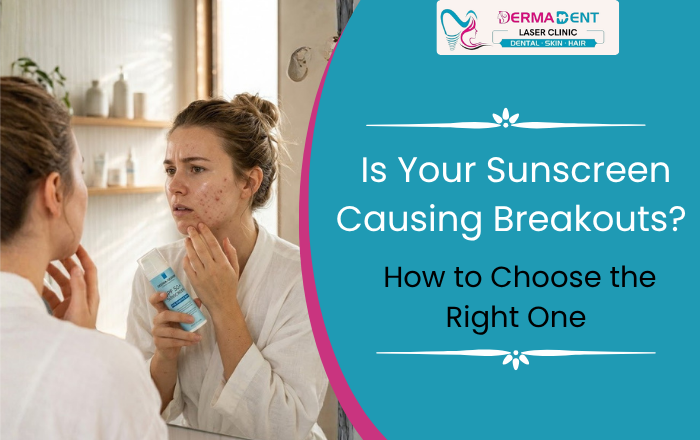
You apply on sunscreen every morning like a good skin-care citizen — and still wake up to fresh pimples. Frustrating, right? Here’s the truth: sunscreen causing breakouts is a real thing, but it’s almost never the SPF itself that’s the villain. It’s the wrong formula for your skin. The great news is that once you know what to look for, you can wear sunscreen every single day without a single breakout. Let’s get into it.
Why Is Your Sunscreen Causing Breakouts?
There are three main reasons your SPF might be triggering pimples:
- Pore-clogging ingredients. Many sunscreens contain comedogenic (pore-blocking) ingredients like isopropyl myristate, coconut oil, or heavy silicones. These sit on top of the skin, trap oil and dead cells, and create blackheads or whiteheads — especially in India’s hot, humid weather.
- Chemical filters irritating your skin. Ingredients like oxybenzone and avobenzone absorb UV rays but can irritate sensitive or acne-prone skin, causing redness and inflammation that looks just like a breakout.
- Heavy, thick textures. Rich creamy formulas designed for dry skin types can suffocate oily or combination skin, trapping sweat, bacteria, and sebum underneath.
Over 60% of people with acne-prone skin avoid sunscreen because it breaks them out — leaving their skin unprotected from sun damage and dark spots.
Chemical vs. Mineral Sunscreen: Which One Is Better for Acne?
This is the big question. Here’s a simple breakdown:
- Chemical sunscreens absorb UV rays and convert them to heat. They’re lightweight and invisible on skin, but they can irritate sensitive skin and sometimes worsen acne.
- Mineral sunscreens (containing zinc oxide or titanium dioxide) sit on top of the skin and physically block UV rays. They’re gentler, less likely to trigger reactions, and actually have mild anti-inflammatory properties — making them a better starting point for acne-prone skin and sunscreen choices.
If you have oily, sensitive, or breakout-prone skin, try a mineral-based, non-comedogenic sunscreen first.
5 Sunscreen Ingredients to Avoid If You Break Out Easily
Flip your bottle around and check the label. These are the ones to watch out for:
- Isopropyl myristate — highly comedogenic, very commonly used as a texture agent
- Coconut oil or cocoa butter — natural but notorious for clogging pores
- Oxybenzone — a chemical filter that can irritate reactive skin
- Artificial fragrance — one of the top triggers for acne cosmetica and contact reactions
- Benzophenone-3 — a known allergen, especially for sensitive skin types
What to Look for in a Sunscreen for Acne-Prone Skin
Now the good part — here’s what your ideal SPF should include:
✅ Non-comedogenic — won’t block pores
✅ Oil-free or water-based — especially important for oily skin in warm Indian weather
✅ Broad-spectrum SPF 30 or higher — protects against both UVA (aging) and UVB (burning) rays
✅ Zinc oxide or titanium dioxide — gentle, effective mineral filters
✅ Fragrance-free — reduces the chance of irritation
Bonus points if your sunscreen for oily skin also contains niacinamide (controls oil and calms redness) or hyaluronic acid (lightweight hydration without greasiness).
4 Application Mistakes That Make Breakouts Worse
Even a great sunscreen can cause trouble if you’re using it wrong.
- Skipping moisturiser underneath. Sunscreen applied directly on bare, dry skin can pill and sit unevenly. Use a light, oil-free moisturiser first.
- Applying too much. A pea-sized amount is all you need for the face. Piling it on creates a thick, heavy layer that traps bacteria.
- Not removing it properly at night. Leftover sunscreen residue is one of the most common causes of congested pores. Use a gentle cleansing oil or micellar water before your regular face wash.
- Forgetting to reapply. SPF breaks down after 2–3 hours. Use a mineral powder SPF or an SPF setting spray to top up through the day without disturbing your makeup.
Best Sunscreen for Different Skin Types in India
- Oily and acne-prone skin: Look for a water-based gel or fluid formula with a matte finish. Formulas with salicylic acid or niacinamide as added actives are a bonus.
- Dry and sensitive skin: A mineral cream SPF with ceramides or aloe vera works well. Avoid anything with alcohol high up in the ingredient list.
- Combination skin: A lightweight lotion or emulsion SPF gives you the best of both worlds.
- Darker skin tones: The white cast from older mineral formulas has been a real issue — but newer tinted or nano-zinc options have solved this. Over 40% of people with deeper skin tones skip SPF because of white cast concerns, which is a serious sun protection gap worth addressing.
When Should You See a Dermatologist?
Switching to a non-comedogenic sunscreen clears up most people’s sunscreen-related breakouts within a few weeks. But see a skin doctor if:
- Breakouts continue even after switching formulas
- You notice itching, hives, or redness immediately after applying SPF
- You’re dealing with deep, painful cystic acne rather than surface bumps
- You’re pregnant or breastfeeding and unsure which ingredients are safe
FAQ
Q1. Can sunscreen really cause pimples?
Yes — certain ingredients can. But SPF itself isn’t the problem. Switch to a non-comedogenic, fragrance-free formula and most sunscreen-related breakouts clear up on their own.
Q2. Should I skip sunscreen if I have acne?
Never. Sun exposure makes post-acne dark spots (hyperpigmentation) significantly worse. The answer is always finding the right sunscreen — not avoiding it.
Q3. Is SPF 50 better than SPF 30 for acne-prone skin?
Both are effective. SPF 30 blocks about 97% of UVB rays; SPF 50 blocks about 98%. The formula and how consistently you apply it matters far more than the number.
Q4. How do I know if my sunscreen is clogging my pores?
Look for small, uniform bumps appearing where you apply SPF, increased blackheads, or a congested texture. A patch test on your inner arm before using a new sunscreen on your face is always a smart move.
Visit Dermadent Laser Clinic, Pune
If you’ve tried switching sunscreens and your skin is still breaking out, it’s time to get a proper skin check-up. Dermadent Laser Clinic in Dhankawadi, Pune, led by Dr. Priyanka Tambe, helps patients find the right skincare routine for their specific skin type. Whether you’re dealing with acne-prone skin, pigmentation, or a damaged skin barrier, you’ll get clear, science-backed guidance to help your skin feel its best.
📍 Dhankawadi, Pune | Book your appointment today.